Park and Ride Düsseldorf: Free at Rheinbahn Stops, Priced at the Airport
Where Hamburg and Munich charge for parking at the station, Düsseldorf leaves almost every Rheinbahn site free of charge — with a single, precisely defined exception at the airport.

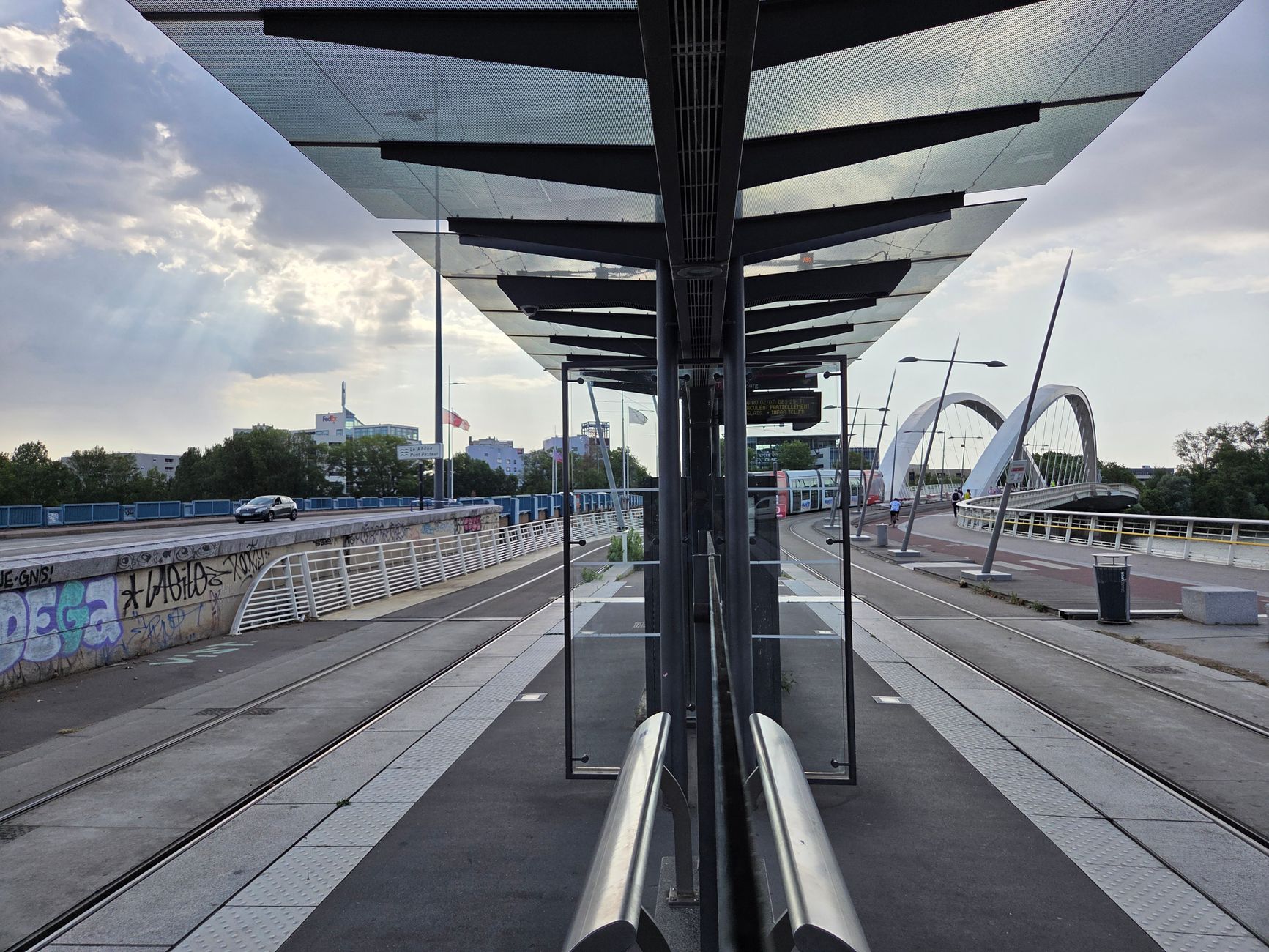
Pull into a park and ride site in Hamburg or Munich and you feed a machine or register a number plate before the barrier lifts. In Düsseldorf, as a rule, you do neither. Rheinbahn’s sites across the city are, with a single, precisely defined exception, free of charge — a finding that looks generous at first glance and reveals a coherent logic of its own on closer inspection.
This piece covers the park and ride stops along Rheinbahn and VRR lines that commuters and visitors from the surrounding area use to switch from car to light rail, bus or suburban train — not the car parks at the terminal itself, which run as a separate system with its own logic of tariff zones and valet providers. The two systems overlap at exactly one point, and it is interesting enough to earn its own section further down.
How the Rheinbahn network is structured
Rheinbahn operates Düsseldorf’s light rail, trams and buses, and is itself part of the Verkehrsverbund Rhein-Ruhr (VRR), the transport association that coordinates fares across the wider region between Duisburg, Wuppertal and the Rhineland. Park and ride sites sit at selected stops on this network, supplemented by a handful of DB stations on the suburban-rail corridor towards Cologne and Solingen to the south and towards Duisburg to the north.
Taken together, the city has more than a dozen sites totalling over 1,400 spaces (as of 2026) — ranging from small lots with a few dozen spaces to large facilities running into the hundreds. In the immediate surrounding area — Duisburg, Krefeld and Meerbusch — the city cites a further 1,200 or so spaces, so commuters from across the wider region find similar provision once they know where to look. Anyone commuting in from the Bergisches Land or the Kreis Mettmann need not drive all the way into Düsseldorf itself to benefit from a free space.
Unlike Hamburg or Munich, Düsseldorf has no central app or unified tariff tier governing use of the spaces themselves — but it does have Rheinbahn’s MobilityMap, an interactive map showing every site along with the lines that serve it, which is worth checking before you set off.
The largest sites at a glance
| Site | Spaces | Connections | Location |
|---|---|---|---|
| Staufenplatz | 300 | U73, U83, 709 | Flingern/Düsseltal |
| Theodor-Heuss-Brücke | 260 | Rheinbahn stop Kennedydamm | right-bank approach to the Rhine bridge |
| Südpark | 259 | U71, U83, U79, 704, 735 | on the A46, near the university |
| Messeparkplatz Nord | 200 | U78 (Sportpark Nord/Europaplatz) | access via A44/B8, Stockumer Höfe |
| Heyestraße/Gerresheim | 160 | S8, S28, S68, U73, 730, 736, 737, 781, M1 | Glasmacherviertel |
| Ickerswarder Straße | 130 | M3, SB57, 731, 735 | Wersten |
| Further Straße | 55, expandable | 730, 785 | Hassels, on the A46 |
Rheinbahn also runs smaller, longer-established sites without a recently published space count: Südfriedhof (line 709, said by the operator to be among the most heavily used sites in the city), Gerresheimer Krankenhaus (U83, 709), Heerdter Krankenhaus (U75) and Wittlaer (U79). Add to those the southern suburban-rail stops towards Cologne and Solingen — Garath, Benrath, Eller and Eller-Süd — plus Hellerhof and, to the north, Angermund towards Duisburg.
Commuting in from the south or south-east, Staufenplatz and Südpark offer the biggest reserves; arriving from the west across the Rhine bridges, Theodor-Heuss-Brücke is the closest option.
Free of charge — but not unconditional
The most striking difference from Hamburg or Munich lies in the payment logic — or, more precisely, in its absence. According to the city council, use of park and ride sites is “free of charge across the whole city area for the time being” (as of 2026). No machine, no day ticket, no annual card tied to a subscription — unlike Hamburg, where the discounted annual card explicitly requires an existing HVV subscription or the Deutschlandticket, as park and ride in Hamburg sets out in detail.
That was not always a foregone conclusion. Some years ago Rheinbahn considered, on a trial basis, fitting the large Südpark site with a barrier, CCTV and a paid model built around an annual card — part of a planned investment programme of around €800,000 that also envisaged better lighting and a real-time occupancy app. As far as is publicly documented, that pilot never grew into citywide charging; as of 2026, use remains free right across the city.
The offer is not entirely without conditions, though. At newer sites such as Ickerswarder Straße or Heyestraße, the city asks drivers collecting their vehicle to show it is genuinely theirs — a simple check against abuse, not a ticket inspection in the Hamburg sense. In practice the system runs on trust: the sites are meant for people switching to transit, not for long-stay storage, but anyone who uses one as a free suburban car park regardless is rarely checked.
For you as a user, the practical upshot is this: there is no sum to work out as there is in Hamburg, where an annual card only pays for itself after fifty trips. In Düsseldorf, the first trip is worth exactly as much as the hundredth.
The one paid outlier: the airport CombiTicket
Exactly one exception breaks this pattern, and it sits in an unlikely place: not at a commuter site, but at the airport. The car park P13, near the light-rail stop Lohausen, offers a so-called CombiTicket that bundles parking with a Rheinbahn journey — the U79 reaches Heinrich-Heine-Allee in the city centre from there in around fourteen minutes.
The twist is that pricing is staggered by group size rather than by vehicle: one person pays around €10, two pay €12, three €15, four €18 and five €20 (valid through 31 December 2026) — each price covering the return journey for the whole group within the Düsseldorf city area. The ticket runs from 9am to 1am for stays of up to eight hours, is non-refundable, and entry has used automatic number-plate recognition without a paper ticket since summer 2025. For major occasions such as Japan Day, the Rheinkirmes funfair or the Christmas markets, the airport also offers discounted special rates on the same product.
What matters here is less the price than how it should be read. This is not a commuter offer like Rheinbahn’s other sites but a day-trip product, aimed squarely at groups arriving by car who want to visit the city centre without hunting for a — considerably pricier — space once they get there. Anyone wanting to park at the airport itself before a flight will find the full rundown of the seven car parks P1 to P8 in Düsseldorf Airport parking; P13 and the CombiTicket sit outside that system entirely and serve a different purpose.
Four new sites since 2020
The network has grown in recent years, and deliberately so at the edge of the commuter catchment. Ickerswarder Straße in Wersten opened in May 2020 with 130 spaces, linked to the Metrobus M3, the express bus SB57 and lines 731 and 735. Two more sites followed in August: Messeparkplatz Nord, with 200 spaces in its first year of operation, reachable via the A44 and B8 near Stockumer Höfe and served by the U78 stop Sportpark Nord/Europaplatz at ten-minute intervals on weekdays between 6.30am and 10pm; and Further Straße/Am Schönenkamp in Hassels, right on the A46, with 55 spaces to start, expandable if needed, served by bus lines 730 and 785. September 2020 brought Heyestraße at the Gerresheim suburban-rail station in the Glasmacherviertel, with 160 spaces and connections to no fewer than nine lines: S8, S28, S68, U73 and buses 730, 736, 737, 781 and M1.
The stated purpose of this expansion was to persuade commuters from the surrounding area — from Erkrath, Mettmann, Hilden, Solingen and Wuppertal — to leave the car at the edge of the city rather than drive it all the way into the centre. That idea is set in a wider regional context in park and ride in Germany.
Further sites are under review for coming years, including one near the ISS Dome and one at Flughafen Bahnhof — the regional railway station, not to be confused with the car parks right at the terminal — alongside a possible capacity increase at Staufenplatz. As of 2026, no firm opening dates had been set.
Bike and ride: six lockable stations
For the last two or three kilometres to the stop, Rheinbahn offers two quite different products. The baseline provision is around 1,437 open, free bicycle spaces across the city — though at busy points such as Oberbilker Markt (91 spaces) or Klemensplatz (76 spaces), the operator reports they are regularly full or overloaded.
For anyone who wants protection from theft and weather, the alternative is six lockable, covered, CCTV-monitored cycle stations: Wittlaer, Klemensplatz, Staufenplatz, Aachener Platz, Holthausen/Bonner Straße and Werstener Dorfstraße/Kölner Landstraße. Each holds 20 bicycles across two green-roofed levels and is booked and opened via the redy app: pick a station on the map, choose a duration, open it on site through the app and enter the PIN at the control panel. Prices run to €1 for 24 hours, €5 for seven days, €15 for 30 days and €40 for 90 days, with a booking extendable up to ten days before it expires. Bicycles up to 1.16m tall, 1.98m long and 0.80m wide fit inside, and the upper level carries an 18kg weight limit. Access is round the clock, with payment by direct debit, credit card or PayPal.
The contrast with the free car space is plain enough: the bicycle costs a small but real sum, and in return it stands dry, locked and reachable at any hour — a sum that, spread across the 90-day card, works out to a few cents a day for a daily commuter.
When park and ride pays off in Düsseldorf
Because the parking itself costs nothing, the calculation in Düsseldorf shifts compared with Hamburg or Munich: the question is never whether an annual card pays for itself, only whether the detour via a Rheinbahn site is worth it against driving straight into the centre.
Three cases argue for it. Anyone commuting from the denser surrounding area but living beyond the reach of the light rail or suburban trains gains, through the short drive to the nearest site, access to a frequency that walking or a bus could not match. Anyone heading regularly into the Altstadt or Carlstadt avoids parking that, in the managed car parks of the city centre, runs to several euros an hour at 2026 tariffs — over a conference or shopping day of eight or nine hours, that adds up to a sum that easily justifies the extra change of transport; what the individual garages between the Rhine embankment and the Kö charge is set out in parking in central Düsseldorf. And anyone travelling in for one of the big events — the Rheinkirmes, the Christmas markets, a trade fair — will rarely find a free space in the central car parks anyway, while the Rheinbahn sites at the edge of town usually still have capacity.
Working against it is what works against park and ride everywhere: the short walk. Anyone who can reach the nearest stop in five minutes makes an unnecessary detour by car. And anyone with several scattered appointments across the city loses more in flexibility in a single day than they save in parking charges — a point that holds, regardless of the local pricing model, for practically every major German city, as the comparison in park and ride in Germany shows.
One practical note to close on: check occupancy via Rheinbahn’s MobilityMap before you set off, particularly at the smaller sites such as Further Straße or Ickerswarder Straße, which deliberately opened with limited but expandable capacity. In Düsseldorf, a full site with no barrier and no display simply means one thing: keep looking.
A system with a different fare structure, tied into the VBB zone system rather than free of charge, is found in Berlin, covered under park and ride in Berlin.
Unlike Düsseldorf’s free system, Frankfurt’s park-and-ride supply is scarce and tied to the RMV ticket, covered under park and ride in Frankfurt.
All figures reflect the position in 2026 and are adjusted independently by the city, Rheinbahn and the airport; before your first trip, it is worth checking current values with the relevant body, particularly for the CombiTicket, whose price list is explicitly valid only through the end of 2026. What stays constant is the structural difference that sets Düsseldorf apart from most other major German cities: no tariff system, no condition, no annual card that only pays off after fifty trips — just a free space near a stop, usable the moment it is needed. The one exception, the airport CombiTicket, proves the rule rather than undermining it: where a service is genuinely being sold, it costs something. More systems compared city by city are covered under Park & Ride.
Keep reading
Park & Ride
Park and Ride in Cologne: Free Parking, but Only With a Ticket
Park and ride in Cologne in 2026: 24 KVB sites, around 5,400 spaces, parking free of charge — with a valid ticket and for no more than 24 hours. Fares, Weiden West, Porz and the low-emission zone.
Dr. Eva Sommer17 September 2026
Park & Ride
Park and Ride Munich: 38 City Sites, Three Price Levels, Day Rates from €1
Park and ride in Munich in 2026: the 38 sites of the city-owned P+R Park & Ride GmbH with more than 14,000 spaces, day rates of €1.00 to €2.00, which U-Bahn and S-Bahn lines they serve, the standard rate for non-travellers, and how it compares with parking in the centre.
Dr. Eva Sommer25 September 2026
Park & Ride
Park and Ride Nuremberg: 645 City Spaces, 300 Across the VGN
Park and ride in Nuremberg 2026: six city sites with 645 spaces, 300+ across the VGN network – mostly free, with app routing rather than a ticket machine.
Dr. Eva Sommer5 August 2026
Park & Ride
Park and Ride in Leipzig: Free, No Ticket Required, No Barrier
Park and ride in Leipzig in 2026: seven city sites with around 3,130 spaces, all free of charge and open around the clock. Fares, the Messe, Stötteritz and the low-emission zone.
Dr. Eva Sommer17 September 2026
Park & Ride
Park and Ride in Berlin: A Patchwork, Not a System
Park and ride in Berlin, 2026: dozens of sites at U-Bahn, S-Bahn and regional stations, mostly free, with no central authority — and a fare boundary that runs through the middle of some stations.
Dr. Eva Sommer6 July 2026