Park and Ride Frankfurt: 2,152 Spaces for 463,000 Commuters
Frankfurt's park-and-ride network barely grew after its last new site opened in 1996, even as the city absorbed hundreds of thousands of car commuters daily. Only the autumn 2025 concept and two RMV-linked pilot schemes have finally set a three-decade standstill back in motion.

Frankfurt likes to think of itself as the city Germany commutes to for work: some 463,000 people travel into the Main metropolis every day, and just under 60 per cent of them do it by car. What was conspicuously missing from that equation for years was a system that intercepts this inflow at the edge of the city before it reaches the centre. Until recently there was remarkably little of one: 13 sites offering just over 2,152 spaces between them, the last of which opened in 1996 — for a city whose commuter numbers have grown steadily ever since. Only a concept published in September 2025, together with two new pilot schemes, has finally set a system that stood still for three decades back in motion.
traffiQ, VGF and the RMV: Three Names for Three Jobs
Understanding why Frankfurt’s park-and-ride offer grew so little for so long means untangling who is actually responsible — and on paper, unlike Berlin’s administrative patchwork, that is clearly defined here. traffiQ, Frankfurt’s local transport authority, was set up in 2001 specifically as the so-called Aufgabenträger: the body that plans, tenders and finances the city’s public transport, and decides which routes run and where new P+R sites should go. The actual running of services falls to VGF, the Verkehrsgesellschaft Frankfurt am Main, which operates the U-Bahn and the tram network, while a number of bus routes are contracted to other operators. Above both sits the RMV, the Rhein-Main-Verkehrsverbund, the regional association that sets the fare every journey is ultimately billed against.
To this three-way split of planning, operation and tariff, the car parks themselves add a fourth layer: the land and buildings belong to different owners — Deutsche Bahn, or more precisely DB InfraGO, at the S-Bahn stations; private operators such as PBG Parkhaus-Betriebsgesellschaft at the Borsigallee car park; and, since January 2026, APCOA, a nationally active private parking operator running the new Niederrad site on the city’s behalf for the first time. Having clear responsibility on paper, in other words, does not mean a single institution actually delivers it.
A Small Number for a Big City
The raw numbers explain why the 2025 expansion drive has met with such broad approval. Before the current programme, Frankfurt had 13 park-and-ride sites offering around 2,152 spaces between them — twelve simple car parks plus the large Borsigallee structure. Set that figure against the roughly 278,000 people estimated to drive into Frankfurt each day (60 per cent of 463,000 commuters), and the existing supply covers well under one per cent of car-commuting demand. Even if only a fraction of drivers could realistically be persuaded to switch, the old network fell far short of what would actually be needed.
The ADAC, Germany’s motoring association, summed up the new concept soberly as a ‘solid foundation’ — noting in the same breath that Frankfurt’s last new P+R site had opened back in 1996. For almost thirty years, capacity barely moved while the city itself, its workforce and its commuter catchment kept growing. More critical voices, such as the Verkehrsclub Deutschland (VCD), still call the current programme a ‘drop in the ocean’ — measured against the sheer number of car commuters, even a doubled supply remains a comparatively modest building block.
The Existing Sites: From Borsigallee to Ostendstraße
Small as the overall supply is, the four sites where it actually exists today differ considerably from one another.
| Site | Spaces | Price | Connections |
|---|---|---|---|
| Borsigallee P+R car park | 899 (14 EV bays) | €1.50 per day | U4/U7 from Kruppstraße |
| Hessen-Center P+R | not published | €20 per month | U4/U7 |
| Niederrad P+R (Aculeum) | 100 | €20 per month | S7/S8/S9, regional trains, tram 12/19 |
| Ostendstraße P+R | not published | not published (as of 2026) | S1–S6, S8, S9 |
The Borsigallee car park in Frankfurt’s east is, at 899 spaces including 14 with EV charging, by far the city’s largest facility. It sits right next to the Hessen-Center shopping centre, stays open around the clock, and costs €1.50 a day — while being explicitly reserved for holders of a valid RMV ticket rather than open to any long-term parker. It is run by PBG Parkhaus-Betriebsgesellschaft, not by traffiQ or the city itself. From the nearby Kruppstraße U-Bahn station, the U7 runs straight to Hauptwache, the city’s central hub, and the U4 straight to Dom/Römer – both via Konstablerwache, in under twenty minutes.
Right next door, also served by the U4 and U7, the pilot site at Hessen-Center has been running since autumn 2025 with its own €20 monthly pass. In the south of the city, a second pilot has been operating since 12 January 2026: 100 spaces in the Aculeum car park on Hahnstraße, roughly 150 metres from Niederrad station, with direct access to the S7, S8 and S9 S-Bahn lines, several regional trains, and tram routes 12 and 19. Booking runs not through a ticket machine but through the APCOA FLOW app; entry and exit are handled by automatic numberplate recognition, with no barrier or paper ticket involved. The condition is a valid RMV ticket covering the Frankfurt zone for at least 30 days — anyone who already holds one pays €20 a month, renewed automatically until cancelled. Wolfgang Siefert, the city’s mobility alderman, framed the expansion as creating a further incentive to switch from car to public transport; traffiQ’s chief executive, Professor Tom Reinhold, stressed that the offer was chiefly meant to make passengers’ daily commute simpler.
The fourth established site sits on the eastern bank of the Main: Ostendstraße S-Bahn station, served by practically every Frankfurt S-Bahn line from S1 to S9. It is the most central of the four options — and, for that reason, arguably the least typical one, since the whole point of park and ride is to move drivers onto rail as early as possible, not as late as the inner city.
A Tariff Tied to Your RMV Ticket, Not a Card of Its Own
Compare Frankfurt’s pricing with other cities and one particularity stands out: there is no standalone P+R ticket you can buy independently of the rest of the network. Hamburg has built its own product, a €100 annual pass linked to an HVV subscription or the Deutschlandticket but nonetheless purchased separately. Frankfurt takes a different route: the new €20 monthly passes at Niederrad and Hessen-Center simply assume that a valid RMV ticket, covering the Frankfurt zone for at least 30 days, already exists. That can be a conventional RMV season ticket, but just as easily the nationwide Deutschlandticket, which has cost €63 a month since January 2026.
So anyone who already commutes and already holds a Deutschlandticket pays, in effect, only the extra €20 for a guaranteed, comfortable space at Niederrad or Hessen-Center — no separate sign-up with a second provider, no additional card in the wallet, just a vehicle recognised by its numberplate. At Borsigallee, meanwhile, the older, simpler model still applies: €1.50 a day, again restricted to RMV ticket holders, but without a minimum term or an app registration. Both models currently run side by side, and it remains an open question whether the city will eventually merge them or let the daily and the monthly logic coexist indefinitely. How differently German cities structure their P+R tariffs, from tiered systems in the south to annual cards in the north, is set out in the nationwide comparison under Park and Ride Germany.
The Autumn 2025 Concept: 2,000 New Spaces, Eight Commuter Corridors
The real change of course is marked by the P+R concept the city presented in September 2025, drawn up jointly by traffiQ and the mobility department. The aim is to roughly double existing capacity to around 4,000 spaces in the medium term — some 2,000 additional spaces spread across several new sites. The plan rests on an analysis that identified eight commuter corridors: road and rail axes along which a disproportionate number of car journeys into the city end, and where a switch at the edge would pay off.
Two sites are judged especially promising and are expected to deliver around 1,200 of the new spaces between them: Römerhof in the west, close to the A5 motorway, and an extension of the existing Borsigallee site in the east, conveniently placed between the A5 and A66. Three further sites — Taunusblick, Kalbach, and Frankfurter Berg, the last a ground-level plot at the terminus of U-Bahn line U5 with around 77 spaces — remain under review; Kalbach and Taunusblick in particular still await a nature-conservation assessment, since both plots border protected landscape areas. Together, these three are pencilled in for roughly 836 further spaces. Separately, the city is examining a considerably larger project at Gateway Gardens near the airport: a car park with at least 1,000 spaces right by the S-Bahn station there, intended to serve commuters as well as visitors to the new multi-purpose arena whose construction is targeted for 2026. The car park at Gateway Gardens in which Fraport runs its Holiday Parking Nord already stands — which raises the question of whether the trip out there also pays for air passengers; the tariffs and the comparison with the terminal car parks are set out under parking at Frankfurt Airport.
No binding completion date exists yet — the city council still has to approve construction and financing proposals, and several sites still await feasibility studies and planning approval. All the space figures quoted here are planning targets (as of 2026) and may still change as the process continues.
Weighing It Against City-Centre Parking
To put the P+R tariffs in perspective, it is worth comparing them with the alternative they are meant to replace: driving all the way into central Frankfurt. There, municipal car parks charge around €2 an hour on weekdays and roughly €1 on Sundays; in the privately run car parks around the Zeil, Hauptwache or the banking district, rates of up to €5.50 an hour are not unusual. An eight-hour working day in the pricier bracket quickly adds up to €30–€40 — every single day, not once.
Against that stands the new €20 monthly pass, which works out at roughly €1 a day even used on every one of twenty-odd working days a month, on top of an RMV ticket you would need anyway. Even the older daily rate at Borsigallee, at €1.50, stays well below any inner-city hourly rate. Unlike Düsseldorf, where the municipal Rheinbahn sites are entirely free, Frankfurt does charge for the space itself — but the gap to the city-centre alternative is wide enough to supply the real incentive, rather than the low price alone.
The Bicycle as Last-Mile Feeder: Quiet Progress at the Stations
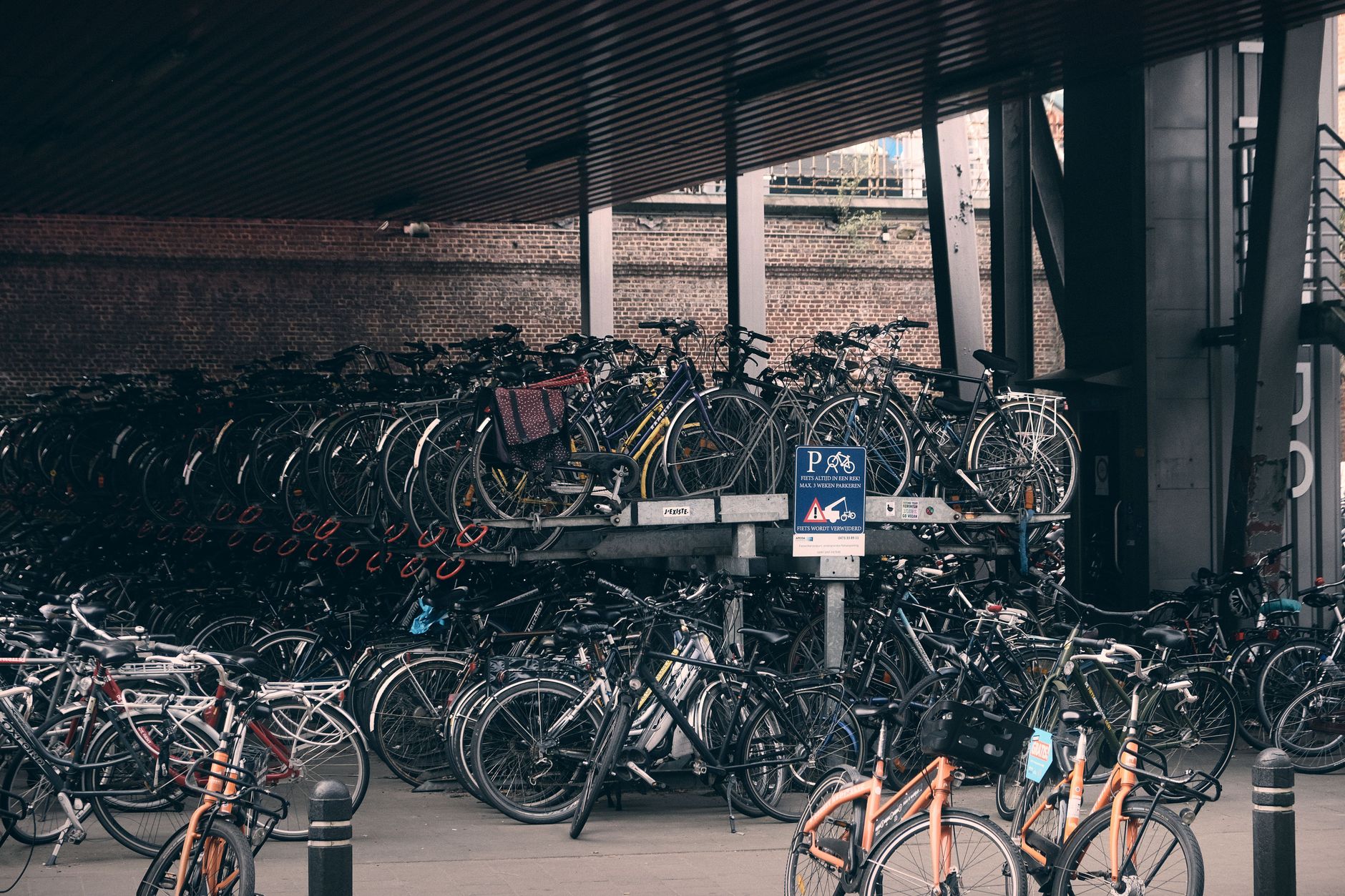
While expansion of car spaces is only just beginning, cycle infrastructure at Frankfurt’s stations has quietly moved forward in recent years — less visibly, but measurably. At Rödelheim S-Bahn station, cycle parking grew from 92 to 208 spaces; at Heddernheim U-Bahn station, from 40 to 124. At Ostendstraße S-Bahn station, a two-tier cycle rack with 48 spaces has been in place since December 2021, fitting substantially more bicycles into the same footprint than a simple row of stands.
For the final kilometre to the station, the bicycle is often the faster and more dependable choice in Frankfurt’s suburbs, since it depends neither on one of the scarce car spaces nor on whether that space is still free at eight in the morning. Anyone living two or three kilometres from the nearest station should weigh this option before relying on an uncertain car space.
When the Detour via the Edge of Town Pays Off
Whether park and ride is worth it for you in Frankfurt today depends, more than in most other German cities, on a single question: can you actually get a space? With only around 2,150 spaces available across the whole system — a figure only just starting to climb — availability, not price, is the binding constraint.
The case for it is strongest where an existing RMV ticket or Deutschlandticket meets a home or workplace near one of the four established sites: anyone already passing Borsigallee, Hessen-Center, Niederrad or Ostendstraße pays only a modest premium on top of a ticket they need regardless — a better deal, in practice, than Berlin, where P+R is mostly free but comes with no reservation whatsoever and the real risk of a full car park by seven in the morning. The case against it is simply the shortage of capacity: anyone who does not live or work near one of the few existing sites will not yet find the comprehensive network that other German cities have long since built.
Another city with a much smaller, but mostly free-of-charge inner-city network is Nuremberg, covered under park and ride in Nuremberg.
If you’re after a subscription model with a low-emission-zone exemption rather than app booking, the VVS system is covered under park and ride in Stuttgart.
If you’re after a car park right at the Festhalle rather than park and ride, concert and trade-fair prices are covered under parking at the Festhalle Frankfurt.
And if you decide against changing at the city edge altogether, the tariffs of the central garages from Hauptwache to Skyline Plaza are set out under car parks in central Frankfurt.
That should change over the coming years, if the sites sketched out in the 2025 concept are actually built. Until then, park and ride in Frankfurt remains what it has historically always been: a small but precisely targeted offer for those who need it in exactly the right spot — and a policy area only now, after thirty years of standstill, beginning to move again. Further systems across Germany are compared under Park & Ride.
Keep reading
Park & Ride
Park and Ride in Hamburg: Two Euros a Day, a Hundred a Year
Park and ride in Hamburg: a €2 day ticket, a €100 annual card and the condition attached to it — plus why usage fell after the charge was introduced.
Dr. Eva Sommer14 August 2026
Park & Ride
Park and Ride in Cologne: Free Parking, but Only With a Ticket
Park and ride in Cologne in 2026: 24 KVB sites, around 5,400 spaces, parking free of charge — with a valid ticket and for no more than 24 hours. Fares, Weiden West, Porz and the low-emission zone.
Dr. Eva Sommer17 September 2026
Park & Ride
Park and Ride in Leipzig: Free, No Ticket Required, No Barrier
Park and ride in Leipzig in 2026: seven city sites with around 3,130 spaces, all free of charge and open around the clock. Fares, the Messe, Stötteritz and the low-emission zone.
Dr. Eva Sommer17 September 2026
Park & Ride
Park and Ride Stuttgart: 215 Sites Between the Basin and the Fildern
Park and ride in Stuttgart 2026: 215 sites with roughly 17,370 spaces across the VVS network, a six-month subscription instead of a day ticket – and why the city's basin shapes where it all sits.
Dr. Eva Sommer11 August 2026
Park & Ride
Park and Ride Nuremberg: 645 City Spaces, 300 Across the VGN
Park and ride in Nuremberg 2026: six city sites with 645 spaces, 300+ across the VGN network – mostly free, with app routing rather than a ticket machine.
Dr. Eva Sommer5 August 2026